
PART 3 - Where Did the Wells Go?
Cornwall did not complete the Star-Newco acquisition. But the wells did not disappear.
They became part of someone else’s plans.
In its 2007 investigation, The Cornwall Local reported that developer Ziggy Brach purchased the Mountainville wells in 2003 and later sold them to the United Talmudic Academy of Kiryas Joel.
That is the outcome former Supervisor Richard Randazzo said Cornwall’s acquisition could have prevented.
“If the town did nothing with it for a decade or two decades the bottom line is we would have had that resource,” Randazzo told The Cornwall Local.
Cornwall would have controlled what happened next. The Town could have tested the wells, evaluated treatment options, protected them for future use or ultimately decided they were not practical to operate. Even if Cornwall did nothing with them immediately, ownership would have preserved those choices.
And years later, the wells continue to matter.
The wells remained valuable long after Cornwall’s attempted acquisition. In 2009, Cornwall-on-Hudson asked Orange County for help acquiring the four dormant wells to protect its future water supply. Had Cornwall completed the acquisition in 2000, it would already have controlled them.
That same year, the Village of Kiryas Joel applied to the New York State Department of Environmental Conservation for permission to withdraw water from Wells 3 and 4 at the former Star property. That application was withdrawn in 2012. But the wells resurfaced again as potential water sources in the environmental review connected to Kiryas Joel’s 2015 annexation process.
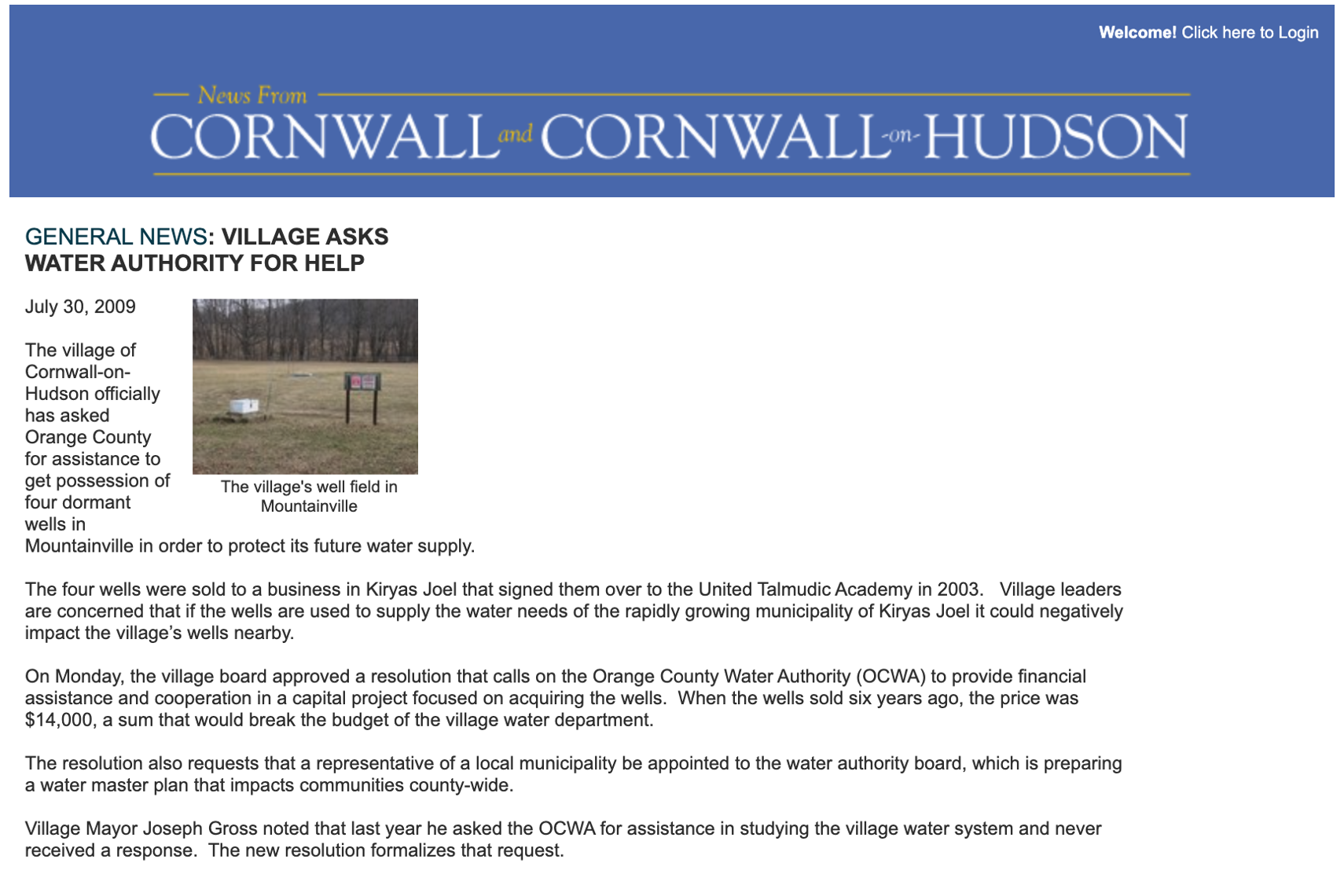
Village Asks Water Authority For Help The village's well field in Mountainville. Cornwall-on-Hudson. July 30, 2009
That does not prove the wells were ready to use. But it does make it harder to dismiss them as a contaminated resource nobody wanted.
The former Star industrial property did have significant environmental problems. Star Newco had undertaken cleanup work before bankruptcy and later investigations identified contamination requiring additional remediation and monitoring. As mentioned in Part 2, contamination at the factory site did not automatically mean the four wells were unusable.
We know the Town reviewed the proposed acquisition under SEQRA and determined that a full environmental impact statement was not required. Its engineer had inspected the water-system equipment. And in May 2000, Town Attorney James Loeb called the system a “MAJOR POTABLE WATER SUPPLY” and a “true BENEFIT for the TOWN.”
However, whatever the wells ultimately required, Cornwall lost the ability to decide their future.
In Part 4, we examine why Helen Bunt’s record on the wells still matters today.